
Desserts
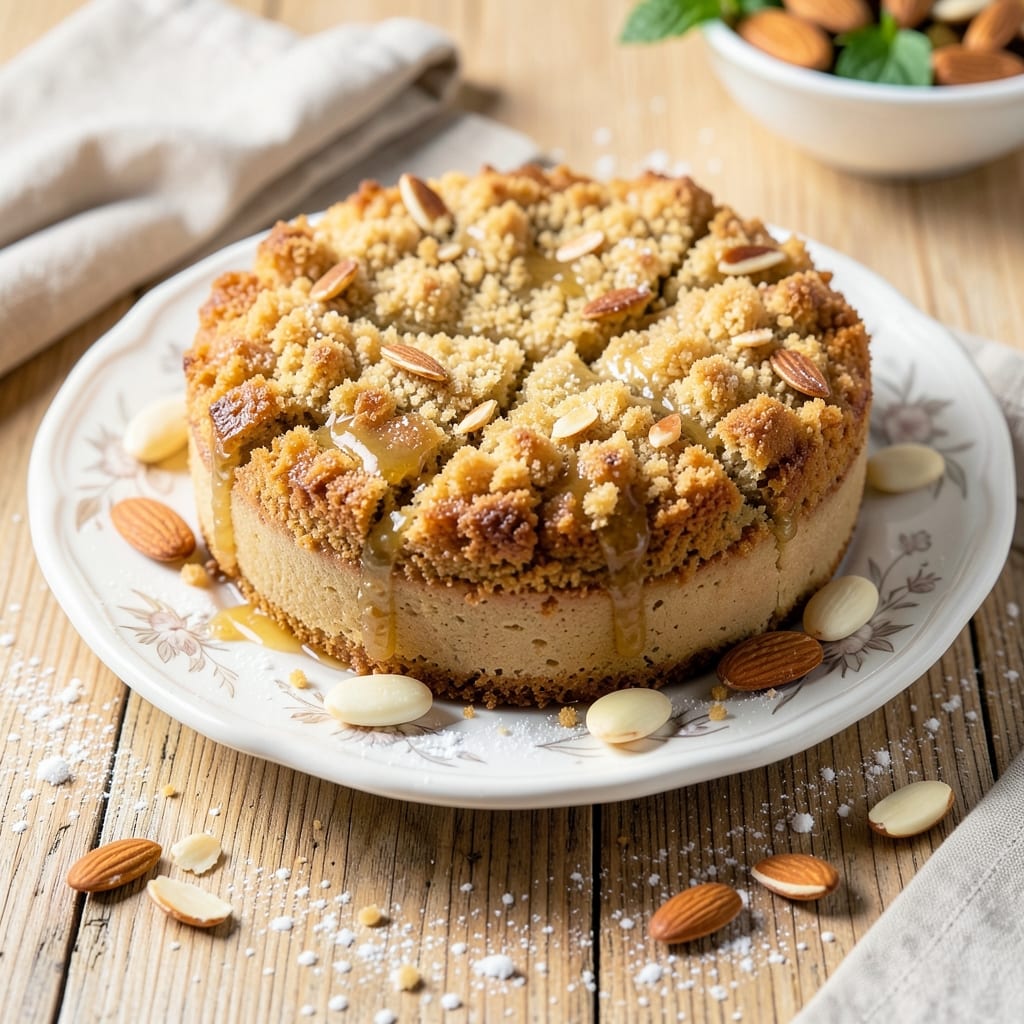
This almond crumb cake recipe delivers layers of tender vanilla cake swirled with nutty almond filling, topped with a golden, buttery crumb crust that cracks perfectly when sliced. 🌟 The secret lies in chilling the cake between layers—this ensures clean cuts and prevents the filling from oozing out. I developed this version after years of testing, balancing sweetness and texture to create a dessert that feels indulgent yet not overly heavy.
The magic happens in the crumb topping, where almond flour meets brown sugar and cold butter for that signature crackly texture. While the cake bakes at 350°F for 40-50 minutes, the aromas of vanilla and toasted almonds fill your kitchen, making it impossible to wait. Each bite offers a perfect contrast: moist cake, rich almond swirls, and a crispy top that melts just slightly with every forkful.
This recipe is vegetarian (thanks to butter and eggs) but can easily be adapted with coconut oil and flax eggs for a vegan version. The cake keeps well at room temperature for 3 days, though it rarely lasts that long—it disappears fast when served warm with whipped cream or fresh berries. Perfect for special occasions or when you want to impress without spending hours in the kitchen.
For best results, don’t skip the chilling step between layers—it’s what transforms this from good to extraordinary. The filling stays thick and gooey, while the crumb topping stays gloriously crisp. Ready to bake?
Ingredients for almond crumb cake
These 13 ingredients create layers of magic—moist cake, nutty filling, and golden crumb topping!
| Ingredient | Amount | Notes |
|---|---|---|
| All-Purpose Flour 🌾 | 2 cups | Sifted for light texture |
| Granulated Sugar 🍚 | 1 ½ cups | White or light brown |
| Almond Flour 🌰 | 1 cup | Blanched, fine texture |
| Baking Powder 🧂 | 2 tsp | Aluminum-free preferred |
| Salt 🧂 | ½ tsp | Fine sea salt |
| Vanilla Extract 🌿 | 1 tbsp | Pure, high-quality |
| Large Eggs 🥚 | 3 whole | Room temperature |
| Unsalted Butter 🧈 | 1 cup | Cold, cubed for crumb |
| Light Brown Sugar 🍚 | ¾ cup | Packed, for crumb |
| Almond Slices 🌰 | ½ cup | Thinly sliced, toasted |
| Almond Extract 🌿 | ½ tsp | Pure, not imitation |
| Powdered Sugar 🍚 | ½ cup | For dusting |
| Heavy Cream 🥛 | ¼ cup | For filling swirl |
The almond flour is non-negotiable here—Bob’s Red Mill or King Arthur brands are my go-tos for that perfect fine texture. Blanched almond flour gives the best flavor, but slivered almonds toasted and pulsed in a food processor work in a pinch. The butter for the crumb topping? Cold cubes are key—don’t let it soften, or you’ll lose that signature crackly texture. I always grab European-style butter from Whole Foods for this recipe—it’s richer and holds up better to high heat. For the almond slices, marcona almonds toasted to a golden brown add an extra layer of sophistication, but regular almonds work just fine if that’s what you’ve got.
No almond flour? Pulse 1 cup of blanched almonds in a food processor—it’s not perfect, but it gets you close. Running short on butter? Coconut oil solidifies like butter for the crumb topping, though it’ll have a slightly different texture. The vanilla extract can be imitation in a bind, but pure Madagascar bourbon vanilla from Trader Joe’s makes this recipe sing. For the filling, if you’re out of almond extract, vanilla + a pinch of cinnamon mimics that nutty depth. And if you’re feeling adventurous, swap the heavy cream for coconut cream—it adds a tropical twist that pairs surprisingly well with the almond flavor.
This cake is a make-ahead dream—bake it a day ahead for even better flavor development. Store it in an airtight container at room temperature, wrapped in parchment to keep that crisp crumb intact. The filling stays gooey for 3 days, but the crumb topping loses its crackle after 24 hours. For serving, dust with powdered sugar right before cutting—that’s non-negotiable. Freezes beautifully too: wrap the whole cake in foil and freeze for up to 2 months. Thaw overnight at room temperature, then dust with powdered sugar to revive that bakery-fresh look.
Why You'll Love This Recipe
- No Mixer Needed: Mixing the dough is a breeze—just fold the almond flour into the wet ingredients until it’s just combined. No overworking, no lumps, and honestly? That’s half the battle won right there.
- Buttery Nutty Magic: The almond flour gives it this unexpected depth—like a cross between a crumb cake and a shortbread, but with that warm, toasty almond kiss. (Yes, even if you’re not a nut lover, this one sneaks up on you.)
- Weeknight or Brunch Star: Slice it thin for a quick breakfast with coffee, or bake a whole pan to feed a crowd—it reheats beautifully. I’ve served it at potlucks, packed it for lunch, and even microwaved a slice for my kid’s school snack. No judgment.
- Pantry-Friendly & Frugal: Uses basic ingredients you already have (check your flour and sugar stash), and the almond flour stretches the batter so you’re not buying specialty items. Plus, leftovers? They last ages in the fridge—if they survive that long.
Step-by-step instructions for almond crumb cake with nutty swirls
Here's how to create that perfect golden crust and buttery almond swirl every time.
🍳 Step 1: Make the Crumb Topping First (This is Key!)
In a medium bowl, combine the 1 cup unsalted butter (cold, cubed), 0.75 cup light brown sugar, 1 cup almond flour, 0.5 cup almond slices, and 0.5 tsp almond extract. Use your fingers or a pastry cutter to work the mixture until it forms coarse crumbs with pea-sized butter pieces still visible. This texture is what gives that irresistible crunch.
Spread the crumb mixture evenly over the bottom of a 9-inch round cake pan (or your chosen pan). Press down gently but firmly—you want it packed but not compacted. This layer will be the star of your cake, so take your time getting it just right. The crumbs should cover the entire bottom completely, leaving no bare spots.
👨🍳 Step 2: Whip the Cream Filling (Light and Airy!)
In a separate bowl, whisk together the 0.25 cup heavy cream, 0.5 cup powdered sugar, and 1 tbsp vanilla extract until soft peaks form. This will be your filling swirl—don't overbeat or it'll turn into butter. Set this aside while you prepare the cake batter. The filling should be thick enough to hold its shape when piped but still light enough to swirl beautifully.
Here's the thing—if your cream isn't cold enough, those peaks won't form properly. I like to chill my mixing bowl and whisk for 5 minutes before starting. This ensures you get that perfect silky texture that swirls so elegantly through the cake.
🍳 Step 3: Prepare the Cake Batter (Don't Overmix!)
Preheat your oven to 350°F while you work. In a large mixing bowl, combine the 2 cups all-purpose flour, 1.5 cups granulated sugar, 2 tsp baking powder, and 0.5 tsp salt. Whisk just until combined—you're not making pancakes here.
In another bowl, beat the 3 whole large eggs until smooth, then gradually mix in the 1 cup unsalted butter (softened) and 1 tbsp vanilla extract. Slowly pour the wet ingredients into the dry ingredients while mixing on low speed. Once combined, stop mixing immediately—overmixing develops gluten and makes the cake tough. The batter should be thick but pourable.
🥘 Step 4: Layer and Swirl Like a Pro
Pour about half of the cake batter over the crumb layer in your prepared pan. Use a rubber spatula to spread it evenly. Then, pipe or spoon the cream filling in a zigzag pattern across the batter. Take your time here—you want those swirls to look beautiful when sliced.
Finally, add the remaining cake batter on top. Use the spatula to gently swirl the batter through the cream filling, creating those iconic marbled patterns. Tap the pan gently on the counter a few times to help release any air bubbles. The top should be smooth but still show the beautiful swirls underneath.
🔥 Step 5: Bake to Golden Perfection (Watch Closely!)
Bake in the preheated oven for 40-45 minutes until the top is deep golden brown and a toothpick inserted in the center comes out clean. The edges should be pulling away slightly from the pan, and you should smell that wonderful almond-butter aroma filling your kitchen.
I know it's tempting to open the oven door early, but resist! The cake needs that full baking time to develop proper texture. If the top browns too quickly, loosely tent it with foil after 25 minutes to prevent over-browning while still allowing it to bake through.
Pro Tips For Making Almond Crumb Cake
- Sift That Almond Flour: I learned this the hard way—almond flour clumps like a stubborn guest who won’t leave. Sift it twice before mixing with the all-purpose flour, especially if it’s fresh from the bag. This keeps your crumb cake light instead of dense, and saves you from overmixing later. ---
- Don’t Rush the Sugar: The granulated sugar isn’t just for sweetness—it’s the glue holding your crumb together. Mix it thoroughly with the dry ingredients (especially the almond flour) until no streaks remain. Skimping here means a cake that falls apart when you slice it. ---
- Test at 340°F: After burning three batches, I finally figured out: almond crumb cake lies about doneness. The oven runs hot, and the top looks golden while the center’s still doughy. Use an instant-read thermometer—pull it at 340°F internal temp, not when it looks done. ---
- Toast the Almond Flour: Sounds weird, but it works: dry-toast the almond flour in a 350°F oven for 5–7 minutes before mixing. This deepens the nutty flavor and cuts the oiliness that can make the crumb cake taste flat. (Yes, even if you’re impatient like me.)
Troubleshooting this recipe
Crumb Topping Too Dry
If your crumb topping comes out dry and crumbly instead of golden and crackly, you likely overworked the butter. The key is to keep the butter cold and work it just until pea-sized pieces remain. I’ve found that using European-style butter (like Plugrá or President) holds its shape better than regular butter. If it’s too dry, try adding 1 tsp heavy cream to the mixture before pressing it into the pan. 🌰
Filling Oozing Out
The filling leaking from the sides usually means the cake wasn’t chilled long enough between layers. After pouring the first batter layer, pop the pan in the fridge for 15-20 minutes to help set it slightly. Also, make sure your cream filling is thick enough—if it’s too runny, add 1 tbsp more powdered sugar to stabilize it. I’ve also had success using Greek yogurt instead of heavy cream for a thicker, less messy filling. 🥛
Cake Too Dense
Overmixing the batter is the #1 culprit for dense cake. Once the wet and dry ingredients are combined, stop mixing immediately. If your cake turns out dense, try folding in 1 tbsp extra heavy cream to lighten the texture. Another trick? Whisk the eggs separately until slightly frothy before combining with other wet ingredients—this adds air for a lighter crumb. 💡
Uneven Swirls
For messy swirls, use a piping bag with a small round tip to create clean lines. If you’re spooning the filling, work quickly and keep the pan level. Pro tip: Chill the pan for 10 minutes after adding the filling but before the final batter layer—this helps the cream set slightly so it doesn’t mix too much with the batter. For extra precision, use a skewer or toothpick to gently drag the batter through the filling in straight lines. ✨
Crumble Not Crispy
If your crumb topping loses its crunch, it likely didn’t bake long enough or got soggy from moisture. Bake the cake 5-10 minutes longer than the recipe suggests to fully set the crumb. For extra insurance, press a second thin layer of crumbs on top before baking. I’ve also had success brushing the crumb layer with a beaten egg wash before adding the batter—this creates a barrier that keeps it crispy. 🔥
Cake Sticking to Pan
Grease your pan thoroughly with butter and dust with almond flour (not flour) for easy release. I swear by Wilton nonstick spray for extra insurance. If it still sticks, try baking on the middle rack instead of the top—this prevents the bottom from overcooking and sticking. For stubborn cases, run a thin knife around the edges while the cake is still warm to loosen it. 🧈
Nutrition facts
Frequently asked questions
Can I make this almond cake without almond flour?
Pulse 1 cup blanched almonds in a food processor until finely ground to replace the almond flour. For extra flavor, toast the almonds first. The texture will be slightly different but still delicious. If you're avoiding nuts entirely, try substituting with 1 cup finely ground oats or coconut flour—just reduce the sugar slightly to balance sweetness.
How do I prevent the crumb topping from getting soggy?
The secret is baking time and technique. Bake the cake 5-10 minutes longer than the recipe suggests to fully set the crumb layer. Also, press a second thin layer of crumbs on top before baking, and brush the first layer with beaten egg wash to create a moisture barrier. Chilling the cake 30 minutes after baking helps preserve that crisp texture too.
What's the best way to store leftovers?
Keep your almond cake fresh by storing it in an airtight container at room temperature for up to 3 days. For longer storage, wrap the whole cake in foil and freeze for up to 2 months. To revive the crumb topping after freezing, dust with powdered sugar and warm in a 200°F oven for 10 minutes. The filling stays gooey even after freezing!
Can I make this cake gluten-free?
Yes! Replace the all-purpose flour with a 1:1 gluten-free baking flour blend (like Bob's Red Mill or King Arthur). For the crumb topping, use certified gluten-free almond flour and add 1 tsp xanthan gum to the cake batter to improve texture. Be sure to check all your ingredients (like vanilla extract and baking powder) for gluten-free certification too. The flavor stays just as rich!
How do I make the swirls look more professional?
Use a piping bag with a small round tip to create clean lines in the cream filling. For even better results, chill the pan 10 minutes after adding the filling but before the final batter layer—this helps the cream set slightly. Work quickly and keep the pan level to prevent messy mixing. A skewer can help drag batter through the filling in straight lines for that bakery-style look.